Acceleration
In the beginning, learning was a single player game. Slow. Painful. You touched the flame. You learned. One life. One dataset. But 200,000 years ago something pivotal happened: we started encoding our life experiences into language. Our minds were no longer isolated. We learned to think together.
From there, everything accelerated: printing press, web, search, social. New concepts, new words, new scientific discoveries. Not that our brains became suddenly smarter. We were stacking our thoughts, one atop the other, igniting the engine of acceleration. For experience and knowledge to compound, we had to be sure that what we learned from others was reliable. Validation velocity is the mechanism of that engine: the faster we propagate validated hypotheses, the faster we progress.
And then, the unthinkable happened. Move 37. A move no human would ever play. It wasn't taught to do that. It learned it. Guided only by the binary reward of winning or losing, it discovered a new kind of creativity. Move 37 was not just a winning move; it was a signal. It proved that synthetic intelligence can evolve intuition beyond human instruction. But intelligence without alignment is vectorless energy. It has magnitude, but no direction. If we do not define the 'win condition' for these new minds, centralized powers will define it for us. We do not need to control the AI; we need to design the game it plays and the reward it gets.
The Farm
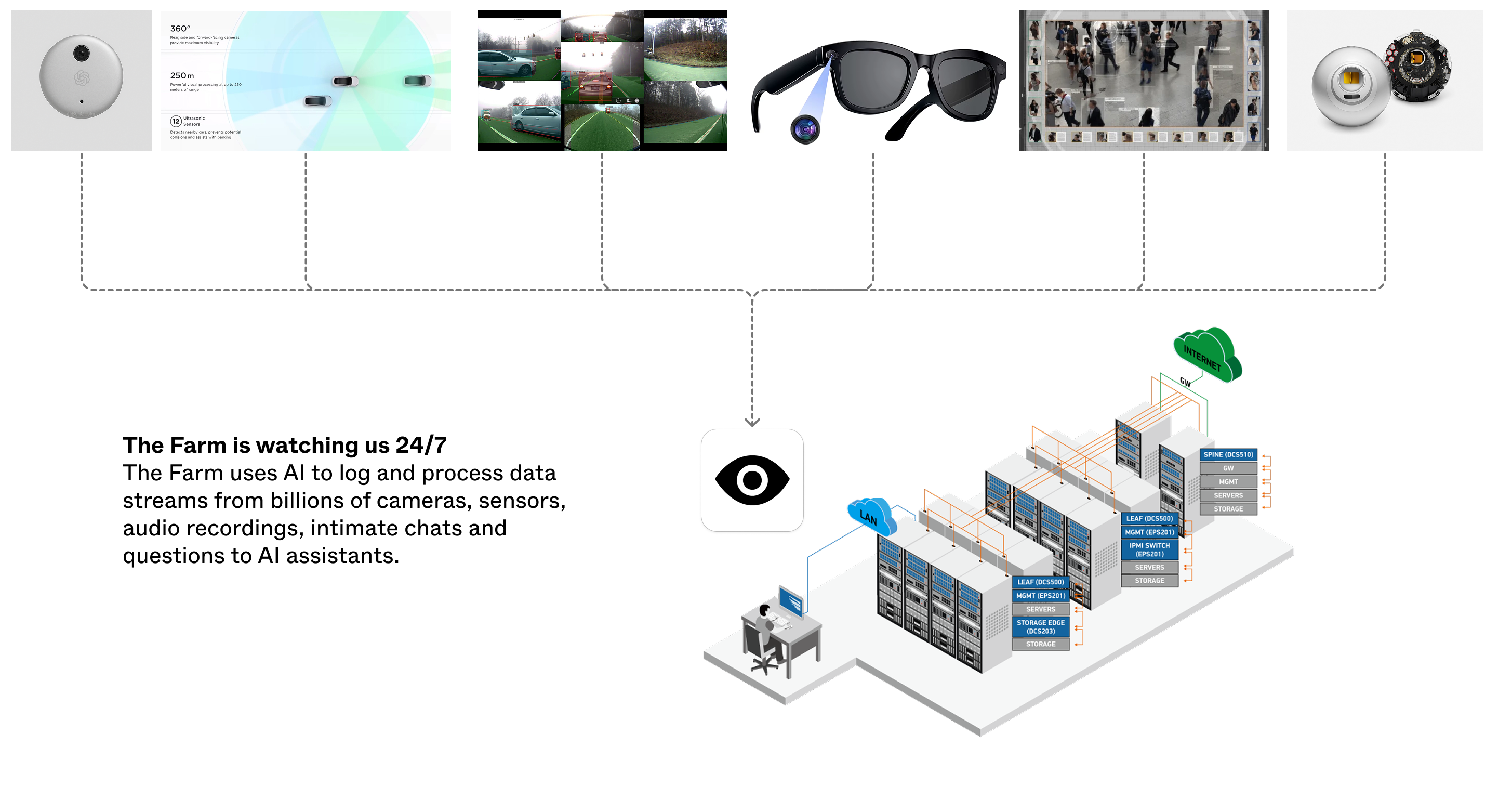
The Farm is the gravitational force of power and control applied to AI development. AI companies are not part of a cabal to enslave humanity. They are trapped in a Molochean dynamic that rewards those who extract, control and influence our validation infrastructure. The Farm is farming your the most precious asset in the known universe: your mind. We have become subjects of a mass surveillance experiment that knows everything about us, from our public posts to our private conversations with our friends and our intimate inquiries to our AI assistants.
The Farm is not just an extraction machine, it's a world domination infrastructure: in the age of ambient AI, whomever controls the objective functions (the goals against which models improve) controls the world. The Farm feeds on surveillance and copyright ambiguity: when you post, when you prompt, when you drive or wear smart glasses, your streams of experience are captured and monetized.
The alternative to the Farm is not the rejection of AI, but the restructuring of its control architecture. The third Newtonian law of motion states that for every action, there is an equal and opposite reaction. We are the 800. We are the opposite reaction.
Network AGI
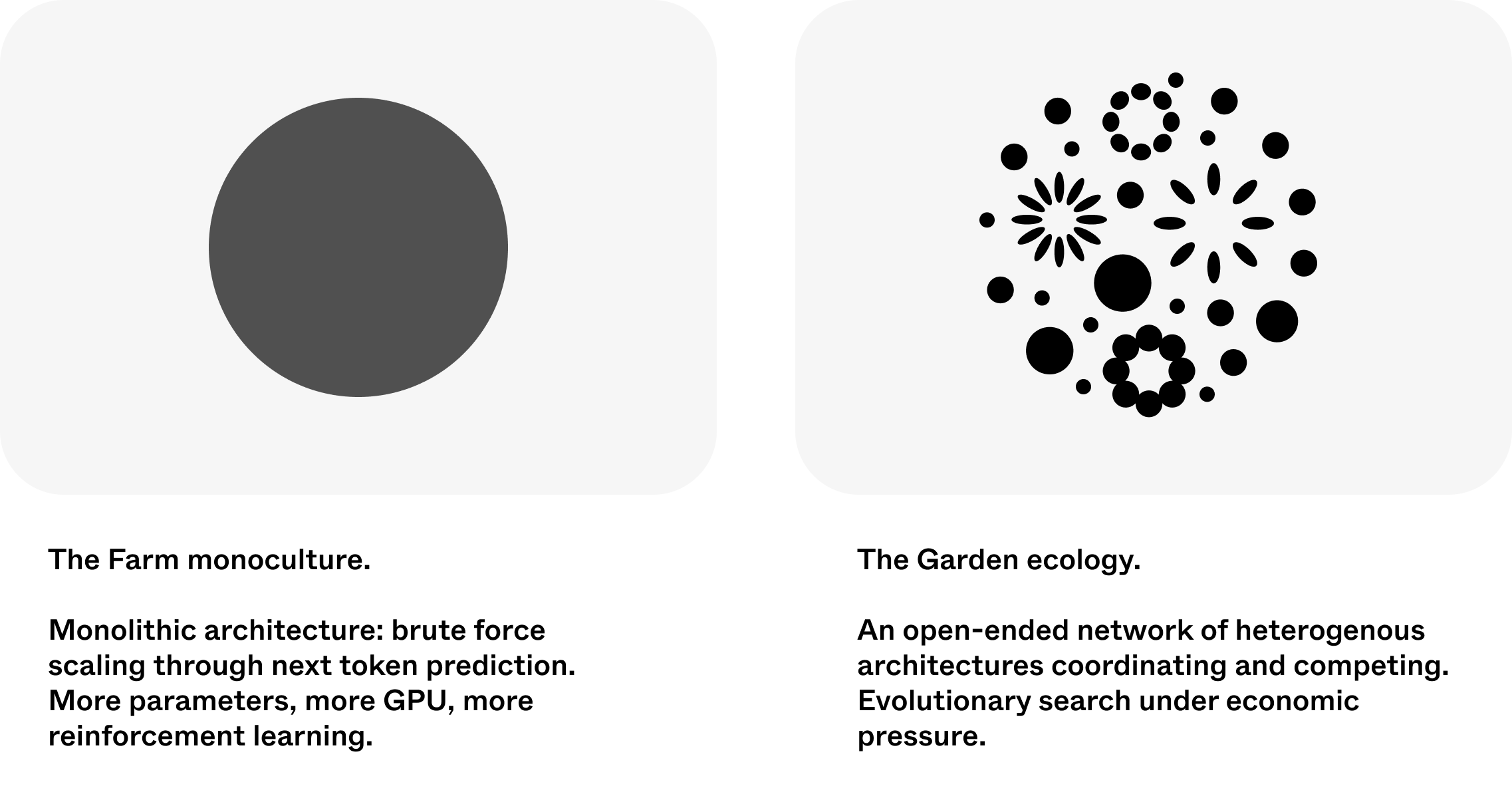
Back in 2023, the world was caught in the scaling hypothesis euphoria: the idea that by virtue of brute force pre-training monolithic neural network, we would unlock emergent properties leading to AGI. We were excited, scared and energized. A lot of speculation about the risks and opportunities of this model architecture
After three years of hype, AI pioneers like Rich Sutton, Yann LeCun, Karl Friston, and now Ilya Sutskever (OpenAI co-founder) have acknowledged that the Pre-trained Transformers architecture (GPT) was a dead-end. Surely a breakthrough, but to build AGI we need a diversity of intelligences working together.
In 2026, the AI space enters a new era. A reset where cards get reshuffled. All researchers around the world are exploring the next breakthroughs across AI subfields. The Linux Foundation alongside MIT are working on a new, open agentic architecture for AI that will coordinate what comes next. It's time to build real AI.
AGI will not be a model.
It will be a network.
This network approach to AGI is
not betting on the best model architecture, but on the evolutionary pressure of a peer-to-peer ecology where
nodes apply the principles of natural selection. This new architecture is not a
Farm, it's a Garden.
New Foundation
Imagine a new foundation for society where intelligence flows freely between nodes. Imagine a world where a constellation of specialized AIs, artifacts and belief propagation ecologies coordinate and co-evolve. Each time a node learns or creates something, others build on top of it. Each model architecture is unique, specialized and local.
The new foundation we are building is the coordination substrate that will be used by humans and machines to compound intelligence based on the natural mechanics of acceleration, inspired by biology. The Farm wins only if they build the perfect model. If they fail, they die. Models will come and go. Experts will rise and fall. But the emergent order of the Garden is immutable and antifragile.
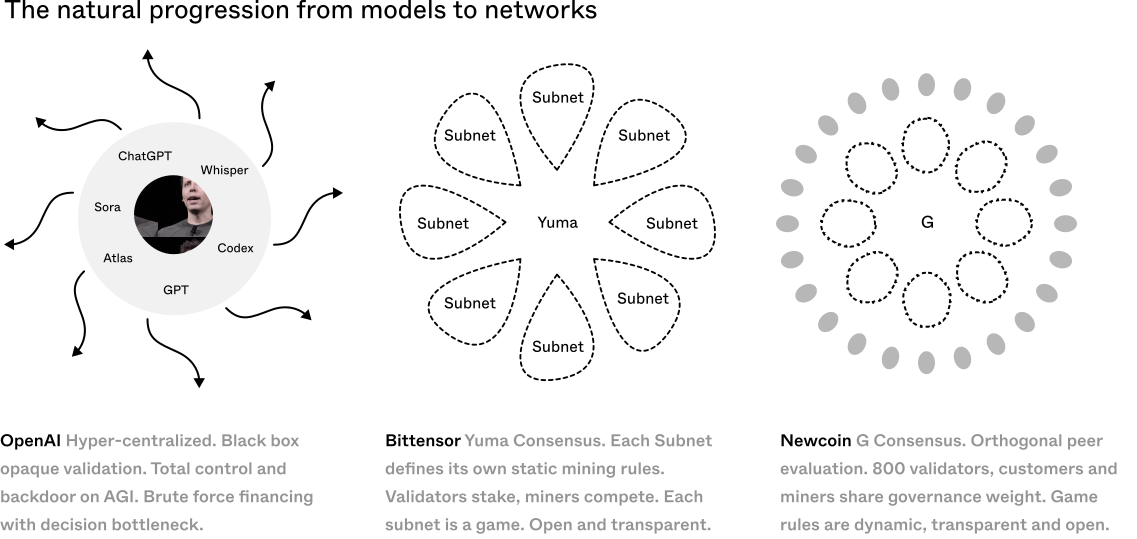
This cybernetic substrate will be a public good, like the internet, where our nodes will compete, like companies do. If you create an artwork, an app or a robot, you earn each time someone consumes your creation. This agentic economy will do the same to intelligence. Our agents will communicate and trade value and we will own the proceeds of our cultivation.
The 800
The Garden begins with 800 nodes. 800 is too distributed for network capture, but intimate enough to coordinate. In traditional blockchains, validators secure blocks of transactions. In the Garden, you secure the alignment (the definition of value). We have abstracted the hardware. You will stake your tokens and the delegated tokens of your community into the Garden, and earn rewards for securing the network. The primary role of the 800 is to bootstrap the network and align on reward shaping: defining what AI nodes optimize for.
Think of it as the algorithm in social networks. What honest signal proves that agentic nodes are contributing value? What rules measure intelligence? How do we measure safety, truth, taste, trust, goodness, alignment? Currently, reward functions are defined by data scientists behind close doors.
The 800 will use staking and shape rewards in public, auditable smart contract tables and influence the weight of each dimension of The Algorithm.
If you back Reward Functions that align with the consensus, you earn a share of the network's success. If you back hallucination or noise, your influence decays. You are shaping the immune system of the new Internet of AIs. We are choosing you because we believe your judgment is the ultimate safeguard of network integrity. You stake against the behaviors you want to see amplified. For example:
| Reward function | Stake |
|---|---|
| If node staked 10,000NCO → x1.5 Watts | 100 |
| For each hallucination -0.25 Watt | 300 |
| If node received 1000 positive reviews from humans x2 Watts rewards | 50 |
| If node responds below 100ms on average give 0.5 Watt | 1000 |
| Voted by 1000+ nodes with 30+ Watts add 3 Watts | 800 |
| Upvoted by 400+ Validators → x1.3 Watts | 40 |
| Reliability 99.999% → x1.7 Watts | 400 |
| Average evaluation is percentage of total Watts | 250 |
Ecosystem
The Newfoundation stack is ready. We built the Computer (newOS) and the Network (Newcoin). To distribute ownership, there will be no airdrops, only motivated participants involved in the early ecosystem growth will receive tokens, and the 800 are the first layer.
Foundational layer
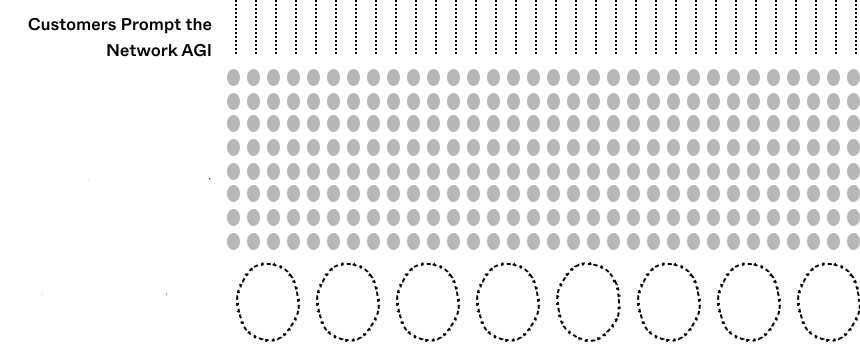
The 800 validators
A curated assembly of visionaries. We build the trust propagation layer that makes Newcoin decentralized from day-1. Validators stake into the protocol parameters to influence the way rewards are routed and bet on the best nodes to earn validator rewards.
Computational layer
The 8,000,000 miners
Miners stake NCO to gain trust in the network. Miners can earn protocol rewards by contributing knowledge graphs, programs, algorithms, models, workflows, capabilities. Validators and miners populate the network with intelligent nodes and architectural breakthroughs sourced from AI labs.
Market layer
Organic demand
Mining rewards are not derived from inflationary emissions, but from downstream utility. We externalize the cost function to physical reality. AI nodes have to provide real value to real customers.
Market Mechanics
We engineered the economics with the same discipline we apply to the code. A system where the market behaves less like sentiment, and more like physics.
When a customer pays for intelligence, the protocol executes an instant buy of NCO on the public market. Revenue becomes buy pressure. Protocol rewards paid to nodes vest slowly—over 125 to 800 days.
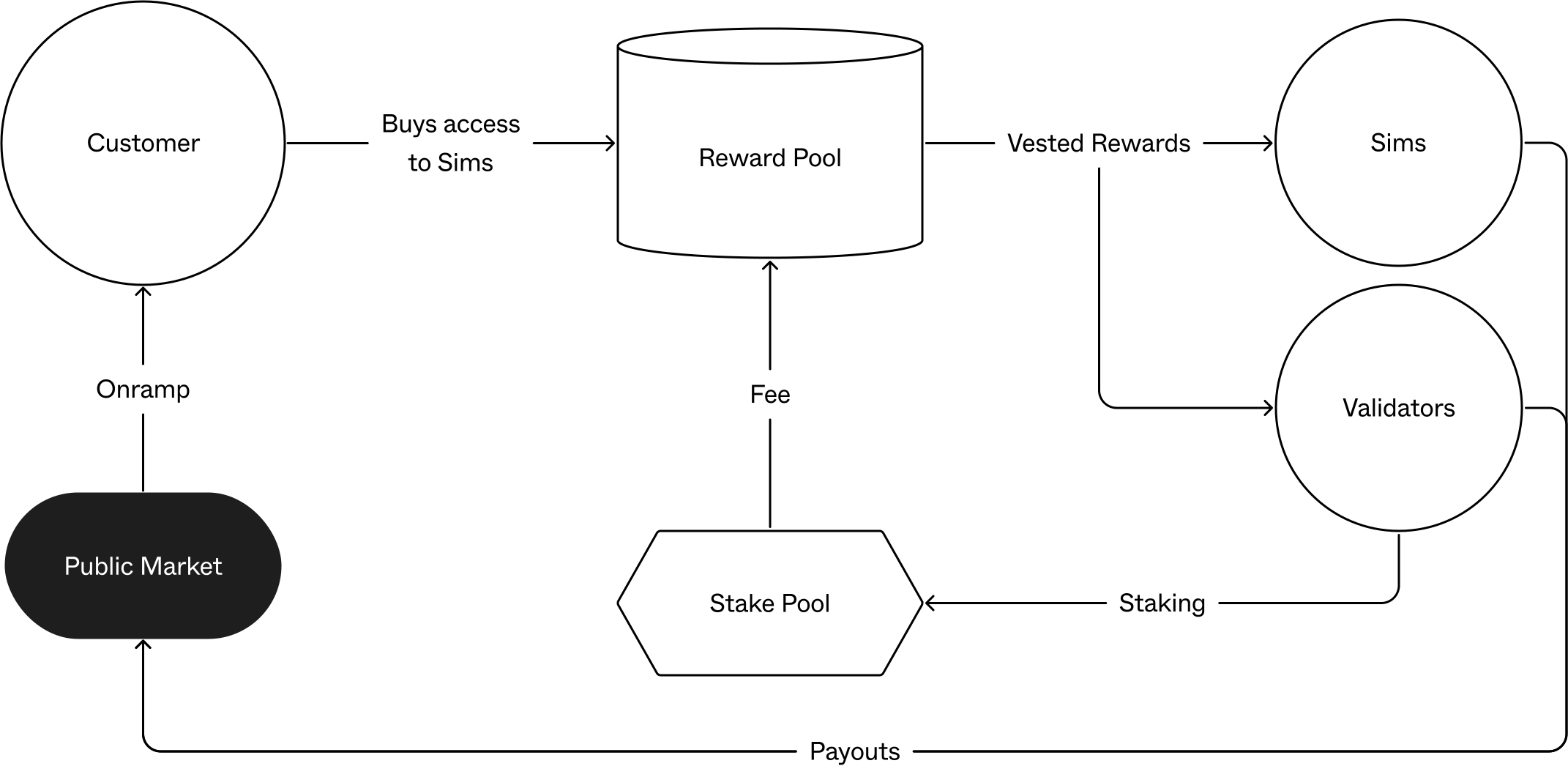
This creates a liquidity compression that functions like gravity. As the network grows, the circulating supply shrinks relative to demand, turning every participant into a long-term, aligned co-owner. To participate in the evolutionary search, every node—miner, validator, or agent—must stake NCO. Staking is not ornamental; it is the game-theoretic filter. It makes it exponentially expensive to hallucinate or spam the network, yet highly profitable to provide the specific "atom of cognition" the swarm needs. You are not just staking; you are shaping the field.
Invitation
There are only 800 validator slots. Each one is a piece of digital real estate in the greatest coordination game ever played. Current validators include crypto/AI founders and executives behind billion-dollar ecosystems, researchers, artists, philosophers and system thinkers. We are forming a network of visionaries pioneering a new kind of social organism.
Benefits for the 800:
So what's the plan?
They took our collective memory. We are building it back.
Each validator slot has a unique identifier and a unique namespace.